Promoting Responsible Care

Message from the Executive Director in Charge

Under its basic principle of “Continuously providing society with the best products through ceaseless progress and the combined forces of our consciences,” the Nippon Kayaku Group positions Responsible Care at the core of its management, and drives forward business activities that demonstrate due consideration of the environment, health and safety.
Recent years have seen a rapid increase in the importance of responding to biodiversity and natural capital alongside the more traditional issues of climate change mitigation and sustainable water resource use. In response to these challenges, we shall move forward with specific and continuous initiatives aimed at GHG emission reductions, improving energy efficiency, optimizing quantities of water used and enhancing wastewater management. These initiatives have already gained strong external recognition, with the CDP*1 awarding us its highest A-rank in the climate change field and an A-minus rank for water security.
We are also proactively engaged in upgrading information disclosures, not only following TCFD*2 recommendations for climate-related information but also commencing nature-related disclosures based on new TNFD*3 recommendations. Our comprehensive grasp of risks and opportunities is therefore not merely limited to climate change, but encompasses natural capital too, and we are moving ahead with initiatives to reflect this in management strategy.
Furthermore, practical application of Responsible Care does not stop with responses to the environment. We will also work on fostering a culture of safety, strengthening chemical substance management, and building relationships of trust with local communities. In similar fashion shall we redouble our efforts to maintain and improve the physical and mental health of employees, and increase wellbeing overall.
Making our initiatives more effective hinges upon the individual actions of every employee. We will therefore press on with efforts to create a daily workplace climate which reflects the fact that each employee perceives responsibility for the environment, health and safety as their own personal issue.
Moving forward, just as before, under the principles of Responsible Care, shall the Nippon Kayaku Group seek compatibility between solving social issues and increasing corporate value, and contribute towards the realization of a sustainable society.
I kindly ask all our stakeholders for your continued understanding and support in this quest.

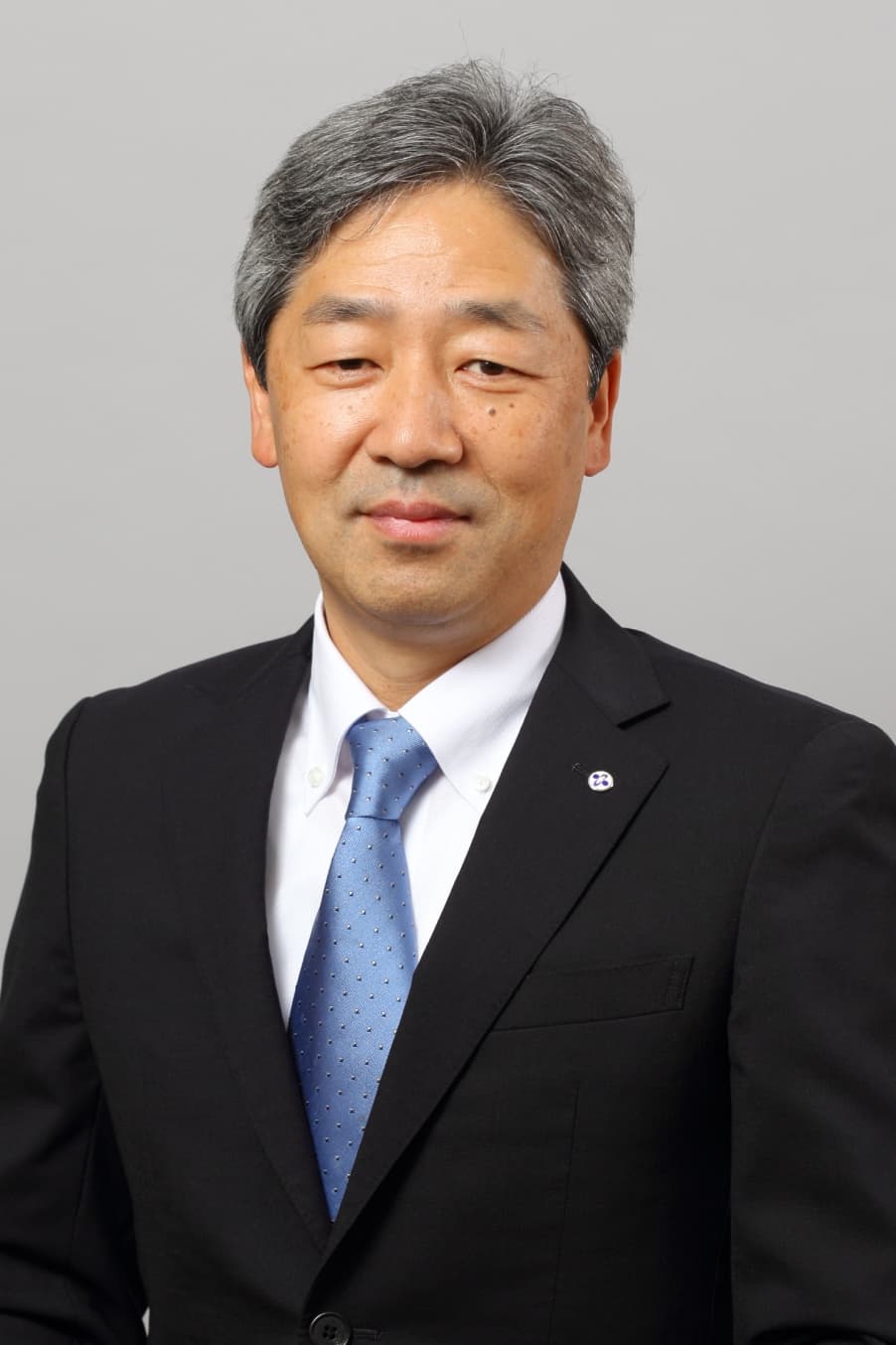
Yasuhito Kato
Managing Director
In charge of Technology Unit

Message from the Executive Director in Charge
  • *1CDP:Carbon Disclosure Project
    An international NGO which requests disclosures of environment-related information (such as climate change measures, water resource conservation and forest conservation) from businesses and cities, examining and evaluating such disclosures, and operating a global information disclosure system.
  • *2TCFD:Taskforce on Climate-related Financial Disclosure
  • *3TNFD:Taskforce on Nature-related Financial Disclosures

Policy and Basic Approach

Our Declaration on the Environment, Health, Safety and Quality

Under the twin spirits of KAYAKU and Responsible Care, we have fixed our “Declaration on the Environment, Health, Safety and Quality,” which is geared towards guaranteeing environmental protection, safety and health, while maintaining and improving product quality. We shall show a united front in promoting these activities, and this declaration shall apply to every employee working for the Nippon Kayaku Group, including temp staff and subcontractors.

Our Declaration on the Environment, Health, Safety and Quality

Established: 1995-11-07
Revised: 2017-05-22
Revised: 2024-01-31

We, the Nippon Kayaku Group, based on the KAYAKU spirit of “Continuously providing society with the best products through ceaseless progress and the combined forces of our consciences,” shall conduct business as a company which contributes to the achievement of a sustainable society that “safeguards the life and health of consumers and supports comfortable living.”

Fundamental policies
  1. We will strive to maintain and improve the environment, people’s health and safety across the entire product lifecycle, from R&D to production, distribution, sales, recycling, and disposal.
  2. We will strive to prevent pollution, protect biodiversity, and conserve the environment by promoting reduction and proper disposal of waste, reduction of resource consumption (of energy, water, and raw materials), and Climate change measures (toward reduction of greenhouse gas (GHG) emissions).
  3. We will actively provide business partners with information needed for the safe usage and handling of our products and for conserving the environment.
  4. We will enhance the quality of not only products, but operating processes as well, and also work to enhance customer satisfaction.
  5. We will heighten employee knowledge and skills through education and training and achieve our goal of zero pollution, zero disasters, zero accidents and enhanced quality.
  6. We will disclose information so that stakeholders correctly understand our business activities and also strive to engage in dialogue with local communities and government authorities.

Nippon Kayaku Co., Ltd.
President and Representative Director

Shigeyuki Kawamura
  • *Responsible Care: Refers to companies which either produce or handle chemical substances proactively taking measures which show consideration for the environment, safety and health, in every process extending from development, sale and use to disposal. Since its launch in Canada in 1985, Responsible Care has gained prominence worldwide, not least in Japan.

Responsible Care Targets

Under its motto of “Safety Over Everything Else,” recognized by all employees, does the Nippon Kayaku Group thoroughly comply with both domestic and overseas laws, and actively work on preventative measures for accidents and disasters affecting both safety and the environment. Furthermore, in pursuit of realizing our KAYAKU Spirit corporate vision do all our employees drive forward Responsible Care activities based on our Declaration on Environment, Health and Safety, and Quality.
The Nippon Kayaku Group Responsible Care Targets have served as our basic approach since FY2019. Working from these have we conducted health and safety activities with an emphasis on unsafe actions based on the findings of 30-second inspections and fixed-point inspections. We have also promoted Environment, Health and Safety Audits with an emphasis on risk management, and are currently fixing targets centered on promotion of decarbonization with a view to achieving our overarching FY2030 Medium-term Environmental Targets.
We have shared and confirmed these targets with domestic group companies, and undertaken annual reassessments as we seek to advance continuous Responsible Care activities going forward.

Nippon Kayaku Group Responsible Care Targets for FY 2026

《Targets》

1. Occupational Health and Safety
  • Serious accidents and hazards: 0
  • Serious environmental accidents: 0
  • Serious traffic accidents: 0
2. Evolution2035 Materiality: Reducing Environmental Burdens through Achievement of KPIs
Indicator Scope FY2026 Target FY2028 Target FY2035 Target
GHG emissions
(Scope1+2)
*Compared with FY2019
Consolidated 98,091t-CO2 or less
(Reduction rate: 25% or more)
36% reduction 64% reduction
VOC emissions
*Compared with FY2024
Consolidated Per-unit emissions of 0.016 or less 1% per-unit reduction 3% per-unit reduction
COD emissions
*Compared with FY2024
Consolidated Per-unit emissions of 0.022 or less
Waste generation
*Compared with FY2024
Consolidated Per-unit emissions of 1.769 or less 1% per-unit reduction 3% per-unit reduction
Recycling Rate Domestic 80% or more 
*including thermal recycling
82% or more 85% or more
Plastic Waste Recycling Rate Domestic 80% or more
Zero-emissions Rate Domestic 1% or less 0.8% or less 0.6% or less

《Priority Initiative Issues》

1. Promotion of initiatives aimed at "zero accidents"; strengthening fire prevention
  • Setting up onsite inspections based on risk assessment deep dives, and audits prioritizing responses to various laws and regulations
  • Setting up 30-second inspections which establish priority themes and encompass all processes
  • Introducing a generative-AI-based safety evaluation system and preparing relevant upgrades for future safety management work
  • Promoting autonomous chemical substance management
  • Preparations against natural disaster risks and emergency situations (guaranteed set up of drills for emergencies, evacuations, general disaster-prevention and lifesaving)
  • Communicating results of Responsible Care activities and challenges to external bodies (applying for external certification)
2. Workplace Improvements to Occupational Health and Safety
  • Preparation of workplaces which take into account the characteristics of older workers (an age-friendly workplace)
  • High-stress workplaces ascertained and targeted for follow-up actions via Stress Check Structure Analysis
  • Establishment and operation of a health check results database
  • Promotion of health management
    • Kenko Investment for Health Accreditation maintained
    • Specific Health Guidance take-up rate of over 30%
    • Health event participation rates of over 60%
3. Promotion of Activities aimed at achieving Environmental Targets
  • Solid implementation of our transition plan aimed at achieving 2030 Environmental Targets
  • Implementation and continuation of risk reduction measures in high-flood-risk regions
  • Strengthening climate-change-related disclosures to external bodies
    • Maintaining our CDP*1 assessment (for Climate Change and Water Security)
    • Establishing indicators and targets based on TNFD*2 boundary extensions, risks and opportunities, and clarification of dependencies and effects
    • Clarification of issues via gap analysis with an eye on post-2030 SSBJ*3 disclosures
  • *1 CDP: Carbon Disclosure Project
    An international NGO which requests disclosures of environment-related information (such as climate change measures, water resource conservation and forest conservation) from businesses and cities, examining and evaluating such disclosures, and operating a global information disclosure system.
  • *2 TNFD: Taskforce on Nature-related Financial Disclosures
  • *3 SSBJ: Sustainability Standards Board of Japan
    Based on the International Financial Reporting Standards (IFRS), these serve as the Japanese version of the disclosure standards laid down by the International Sustainability Standards Board (ISSB) which enable companies to disclose their sustainability information to financial statement standards.

System

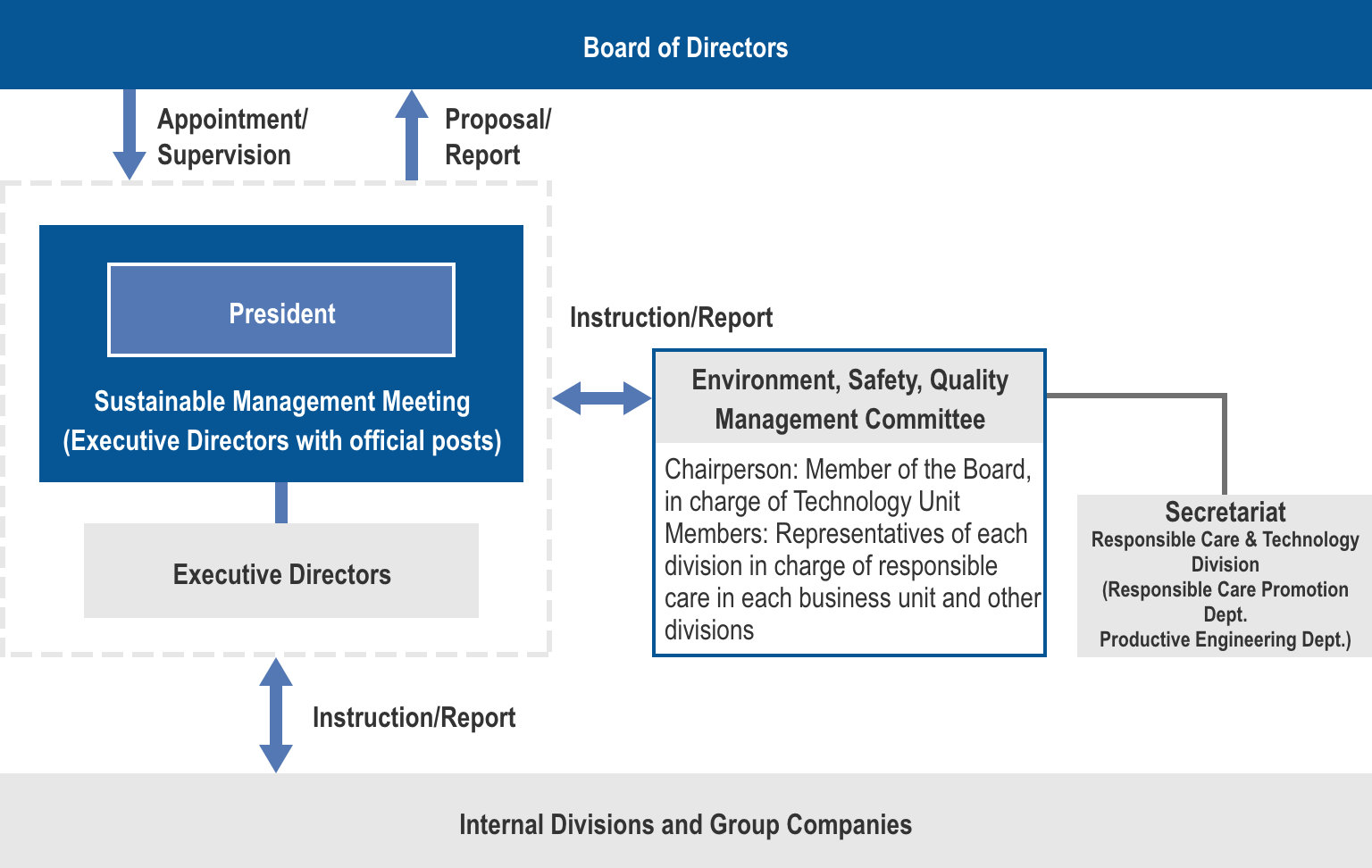
Our Group’s Responsible Care Activities are coordinated by the Committee for Environment, Safety and Quality Management, set up as an advisory body to the Sustainable Management Meeting chaired by our President.
This Committee is comprised of persons in charge of Responsible Care Activities from each business unit, as well as managers from each section of our General Administration Department, which is unattached to any business units. The Committee’s remit is to discuss the status of Responsible Care-based activities as well as any problems arising from them and how to respond, and to deliberate policy proposals for the next financial year and for the resolution of climate-change related matters. The results of its discussions are reported to the Sustainable Management Meeting.
Our Environmental Protection & Safety Division, meanwhile, conducts Environmental, Health and Safety Audits of each business site and group company as an organizational activity, and reports the results to the Committee for Environment, Safety and Health Management.

System

Responsible Care Audits

Basic Approach

Based on the Annual Responsible Care Plan, the Nippon Kayaku Group conducts internal audits of each business site and a section of Group companies in the form of Environment, Health and Safety Audits. These audits represent a structure for ascertaining whether business activities are indeed showing due consideration to the environment, safety and health, and promoting improvements in response to problems detected. Specifically, these Checks involve inspecting items related to Responsible Care, environmental conservation, disaster prevention, distribution safety, biodiversity, occupational safety, compliance, proper health management, and management of chemical substances, and providing relevant improvement advice and suggestions. By enabling us to prevent compliance violations and unjust or erroneous practices, and devise improvements in the fields of the environment, health and safety, these audits help to build, maintain and improve the Nippon Kayaku Group's internal control system.

Management System

Environment, Health and Safety Audit Team

Our Team is comprised of Responsible Care & Technology Division managers (Team Leaders), Responsible Care & Technology Division Responsible Care Promotion Dept. members (inspection team and office staff), and Labor Union Head Office staff.

Items to be checked
  • Status of Responsible Care Activities via the Responsible Care Progress Confirmation Chart
  • Implementation status of risk management concerning production processes and high-hazard-risk equipment
  • The effects of responses and recurrence prevention measures for past accidents and hazards
  • Area inspections (30-second patrols and fixed-point inspections)
  • The storage and management situation for chemical substances
  • The Environment, Safety and Health system and compliance status for related laws and regulations
  • Other necessary items related to Responsible Care
Locations to be checked
  • All Nippon Kayaku business sites (7 plants, 3 research labs, 2 offices, 3 other bases)
  • Domestic Group companies (3 onsite, 1 offsite)
  • Overseas (China-based) Group companies (3 companies)
Frequency of checks

We conduct audits every 1-2 years based on the size of the business site in question and the previous year's inspection results. Depending on inspection result contents and the subsequent situation, we may also stage follow-up checks. (In the event, none were conducted in FY2025).

Reporting of Inspection Results

We provide inspection result feedback on the following categories.

  • Good points: Excellent initiatives which can serve as reference points for other business sites and the rest of the Group
  • Points raised: Items carrying risks related to accidents, hazards, environmental incidents, and compliance violations
  • Points noticed: Items which demand improvements in initiatives concerned with safety and health, environmental conservation and compliance
  • Suggestions: Items which pose no problem at present, but with the implementation of a suggestion or two could deliver even better initiatives in terms of environment, safety and health.

Inspection results are reported to the business site or Group company inspected, related business units, the Environment, Safety and Quality Management Committee, and the Audit Division. In response, the inspected business units and group companies will address any problems discovered by undertaking systematic improvements in the form of PDCA cycles.

Targets and Results

Environment, Health and Safety Audit Results (Number of bases inspected)
Business Units examined; Group companies 2022 2023 2024 2025
Plants 7 7 7 6
Research labs・Offices 4 1 1 1
Domestic Group companies Onsite 3 3 3 3
Offsite 1 1 1 0
Overseas Group companies* 3 1 2 2
Total 16 13 14 12
  • *Checks for Overseas Group companies have been conducted via an online meeting system involving a Responsible Care Progress Confirmation Chart only.
FY2025 Inspection Results (Number of points raised at the 12 bases inspected)
Areas Responsible Care Progress Confirmation Chart, Responses to legislation, Base inspections etc.
Good points 35
Points raised 10
Points noticed 96
Suggestions and requests 85

Initiatives

PageTop
Our Business
R&D
Corporate Information
Global Network
Investor Relations
Integrated report
Sustainability