Information may be obtained or stored in your browser by cookies when you access the Website. This information is related to the user, the user settings or device. It is primarily used to ensure the site functions as expected by the user. We respect your right to privacy. Therefore, you can select to not allow some types of cookie. Please click on the different category headings to check the details and then change our default settings.
Strictly Necessary Cookies are cookies that are essential for this site to function properly. Strictly Necessary Cookies do not store information that can identify individuals. Strictly Necessary Cookies are used to view this site. Therefore, you cannot refuse the use of Strictly Necessary Cookies from these cookie settings. However, you can refuse the use of Strictly Necessary Cookies from the settings of your browser at any time. Please note that parts of the site may not function if you refuse the use of Strictly Necessary Cookies.
This site uses the following Strictly Necessary Cookies.
Cookie name: gdprCookieEn
Cookie name: optGA
Cookie name: optPardot
We are focusing our research and development efforts on four target areas that contribute to a sustainable society by leveraging core technologies and open innovation.
Alongside our core business areas and adjacent fields—Mobility, Electronics, and Life Sciences—we are advancing R&D in the Environmental & Energy field, which contributes to carbon neutrality. This is being done primarily through our corporate research organization, the New Business Development Center, actively utilizing industry-academia collaboration and partnerships with startups.
(horizontal scrolling)
| Mobility | Environment and Energy | Electronics | Life Science |
|---|---|---|---|
|
|||
※ Initiatives of business alliance with AZUL Energy Inc. |
Will also continue to collaborate with the fine chemicals business unit on planning and marketing |
Will also continue to collaborate with the pharmaceuticals group and agrochemicals group on planning and marketing |
|
Toward the realization of a carbon-neutral society, there is attention on green hydrogen that is manufactured through water electrolysis using renewable energy without emitting carbon dioxide.
According to the International Energy Agency, the global hydrogen market is expected to grow to an annual scale of several trillion yen by 2030. The Japanese government has also positioned hydrogen as a key energy carrier toward achieving carbon neutrality.
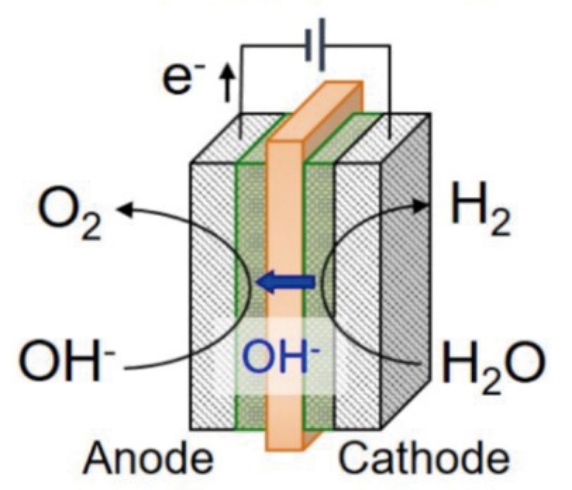
Currently, water electrolysis using proton exchange membranes is the mainstream. Cost is an issue as it requires catalysts that use rare metals such as platinum. In recent years, there is attention on water electrolysis using anion exchange membranes where affordable metal catalysts, such as nickel, are used and efficient production is possible. It is looked upon as a potential next-generation hydrogen production technology.
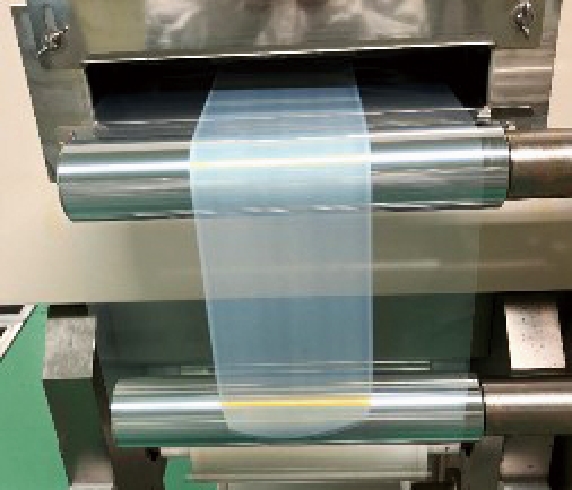
However, durability was an issue for practical application as anion exchange membranes are used for long periods of time under high temperatures and alkalic conditions. At the Institute of Science Tokyo, an anion exchange membrane with excellent long-term durability was successfully developed using material design based on analyzing the deterioration mechanism. Nippon Kayaku is using our polymer material molecular design and synthesis technology nurtured through functional materials and our Polatechno Business’s precision film processing technology to collaborate with the Institute of Science Tokyo and work on the commercialization of anion exchange membranes from the aspects of establishing the process and achieving mass production.
Full-scale market expansion is expected from 2030 onward, and we plan to start providing domestic manufacturers with development samples for demonstration from 2025. Through this initiative, we will achieve affordable green hydrogen production and contribute toward the realization of a hydrogen society and the strengthening of competitiveness of industries in Japan.
Technology Unit
R&D Planning Division,
New Business Development Center
Naoki Yanagibashi
Concept of water electrolysis using anion exchange membrane
Anion exchange membrane fabricated using roll-to-roll processing
In recent years, there has been a rapid increase in fires from lithiumion batteries found in smartphones, mobile battery packs, electricassist bicycles, and such. According to statistics from Tokyo Fire Department, there were approximately 300 cases of fire deemed to be caused by lithium-ion batteries in the five-year period from 2019 to 2023. This growing trend is becoming a severe social issue.
Lithium-ion battery fires are difficult to extinguish using common methods such as cutting off oxygen and spraying water due to reasons including the generation of flammable gases within the battery, combustion at high temperatures above 800°C, and the risk of reignition after extinguishing.
At Nippon Kayaku, we have developed an innovative fire-extinguishing component using the expertise of the Safety Systems Business, such as the handling of pyrotechnics and other reactive substances and extrusion processing technology for manufacturing gas-generating agents. It is a fireextinguishing component specifically for lithium-ion batteries, automatically reacting with high heat and instantaneously releasing effective fire-extinguishing agents. The negative catalytic effect of the released potassium radicals can quickly extinguish the flames of a lithium-ion battery, minimizing damage by effectively preventing the fire from spreading to other battery cells and peripheral devices.
Amid progress in the full-scale adoption of electric vehicles and mandatory collection of lithium-ion batteries, safe handling and processing techniques will become increasingly important. Significantly improving the safety of lithium-ion batteries, our technology for fireextinguishing components will be an important solution meeting these social requirements.
Technology Unit
R&D Planning Division,
New Business Development Center
Kenichi Inaba
The fire can be rapidly extinguished using the negative catalytic effect of potassium radicals
by bringing the fire-extinguishing sheet close to the burning object
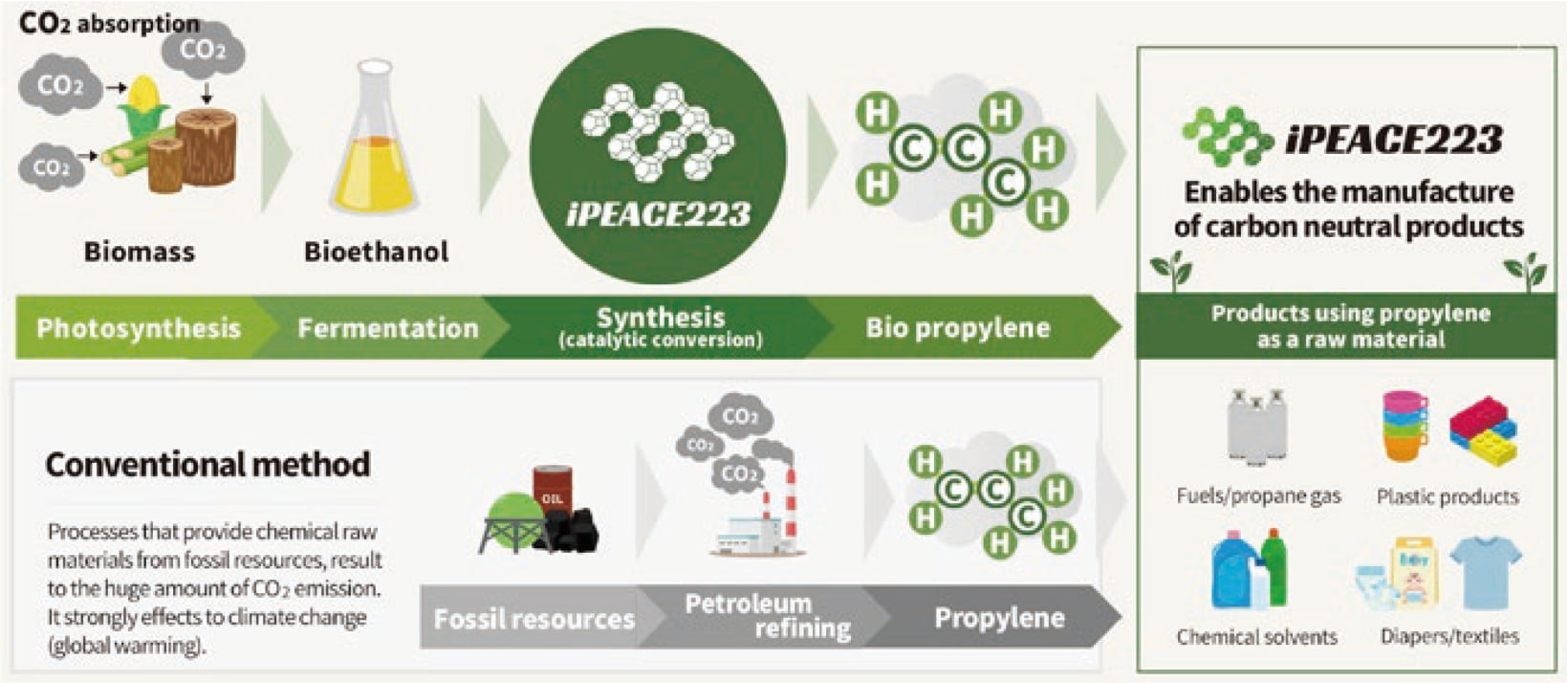
Toward achieving carbon neutrality by 2050, the world is currently facing the major issue of moving away from dependence on fossil fuels. To address this issue, we saw great potential in the unique zeolite catalyst technology of iPEACE223 Inc. In FY2024, we invested in iPEACE223 and embarked on full-scale joint research and development.
iPEACE223 develops an innovative catalyst and process for high-efficiency, low-cost production of propylene—a raw material for plastics and synthetic fibers—from bioethanol, a fuel additive that is widely used worldwide. This “green propylene” has the potential to significantly contribute to decarbonization across the supply chain as a fuel and as a raw material for acrylic acids and methacrylic acids, which are also part of our business.
The greatest feature of iPEACE223’s technology is that it can produce propylene from ethylene in one step with extremely high efficiency using its unique zeolite catalyst. Besides solving the issue of exchange efficiency in existing multi-step production methods, it can limit energy-equivalent CO2 emissions to about one-third compared to petroleum-based processes.
We are advancing practical application of this innovative technology by combining the innovative catalyst and plant design technologies of iPEACE223 with the catalyst development and industrialization expertise of Nippon Kayaku. We are accelerating development, aiming for catalyst launch in 2030 as well as stable supply. Nippon Kayaku will continue to promote research and development that provides green materials as options for all aspects of life.
Fine Chemicals R&D Laboratories
Catalyst Group
Kyosuke Gomi (left)
Technology Unit
R&D Planning Division,
New Business Development Center
(stationed at Asa Plant)
Michiharu Arifuku (middle)
Fine Chemicals R&D Laboratories
Catalyst Group
Shogo Yasuda (right)
Web site of iPEACE223 Inc.(https://ipeace223.com/en/)