


KPM DFR Series
The KPM Series provides structure formation and substrate bonding in a single material
The KPM DFR Series is a negative-tone dry film resist based on epoxy resin and developed for use as a permanent structural layer.
Its low-halogen, antimony-free formulation enables the formation of chemically and thermally stable structures. The material also offers strong adhesion to substrates, allowing it to function as a patternable bonding material through standard exposure processes.
Typical applications include wall formation for cavity structures in sensor packages, microfluidic channels, and various bio-device components. The series has demonstrated very low cytotoxicity, as confirmed by ISO-10993-5 testing.
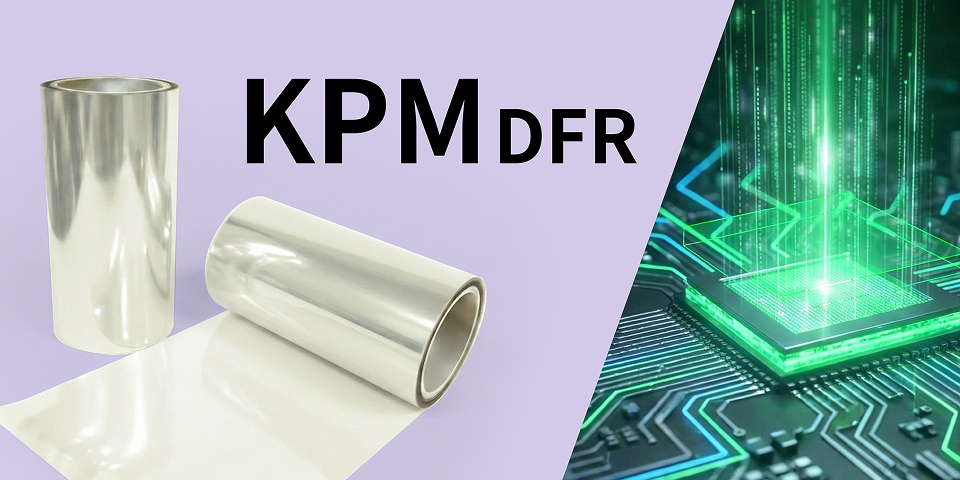
KPM-500 DFR
Key Features of KPM-500 DFR
- ● Negative‑tone, photosensitive resist designed for wafer‑to‑wafer bonding
- ● Sensitive to broadband and i‑line exposure
- ● Compatible with 2.38% TMAH developer
- ● Enables void‑free bonding at low temperature (150°C)
- ● Excellent adhesion to a wide range of substrates

Product Formats
We also offer film thickness options other than 40 μm and 80 μm to meet customer requirements.
- ● Uses high‑purity, low‑halogen resin supplied by Nippon Kayaku
- ● Suitable as a chemically and thermally stable bonding material for sensor packages and microfluidic devices
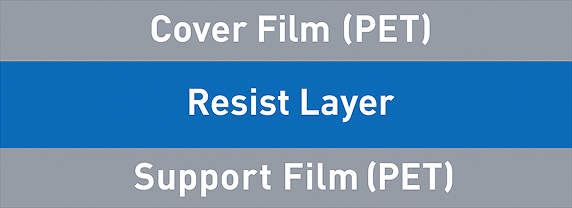
Film Structure
Appearance
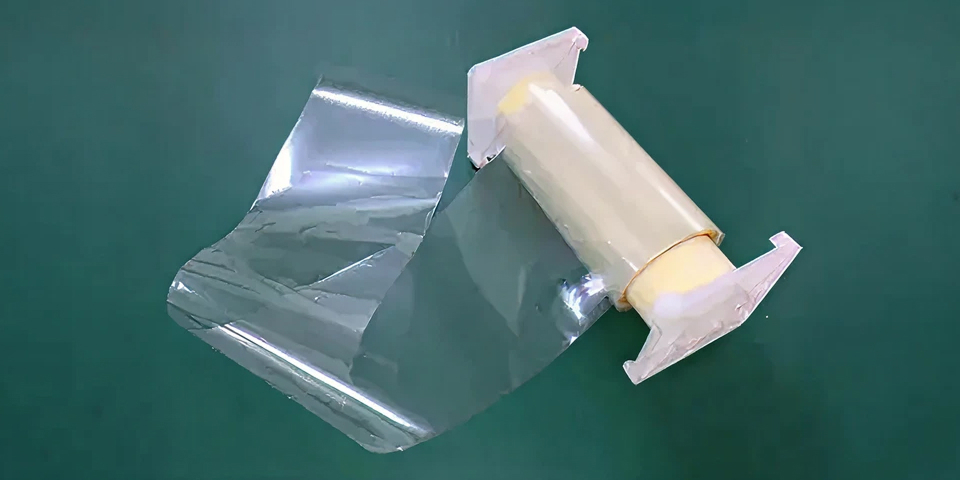
※Images are for illustration purposes only.
Product Specifications
 Scroll horizontally to view more.
| KPM-500 DFR | |
|---|---|
| Resist layer thickness | 40, 80μm |
| Roll length | 25m |
| Recommended storage conditions | Frozen (below –20°C) |
Advantages of Dry Film for Si‑Glass Bonding
Our dry film provides excellent thickness uniformity, enabling defect‑free bonding across the entire substrate, including the outer edges. This improves the number of usable chips per wafer and can contribute to overall cost reduction.

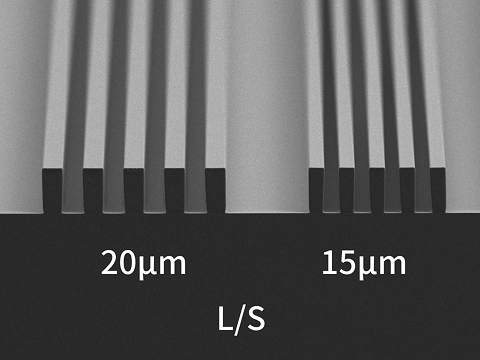
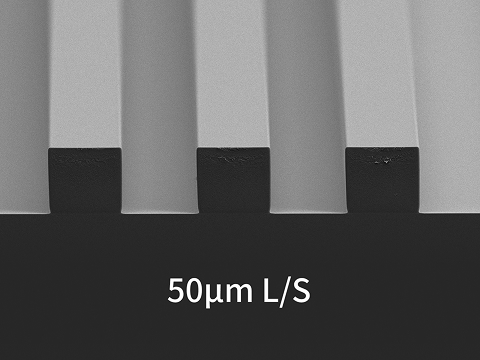
Resolution on Si Substrates
The material supports fine, high‑aspect‑ratio patterning with vertical sidewalls. Its strong adhesion enables stable pattern formation even for small, intricate structures, supporting device miniaturization and functional enhancement.
- ● KPM film thickness: 40 μm
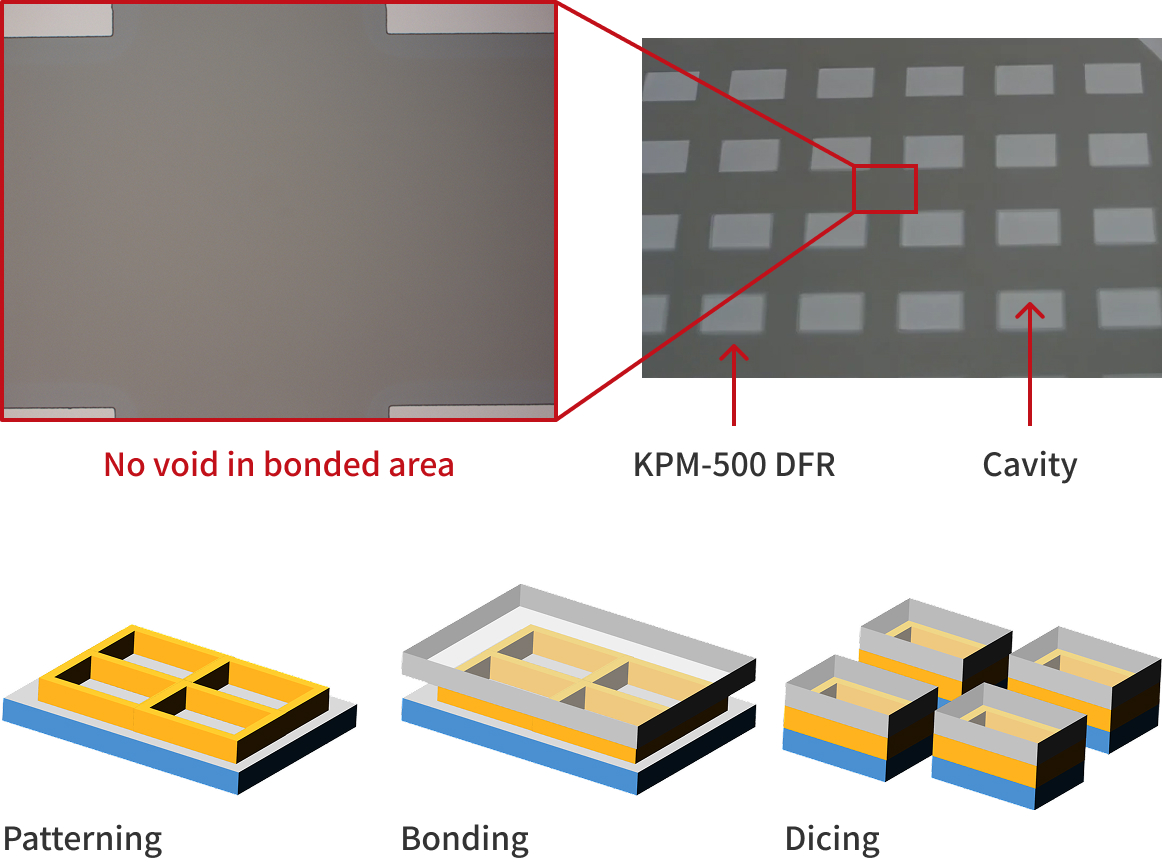
Si-Glass Bonding
KPM‑500 DFR achieves both strong adhesion and mechanical strength, resulting in reliable bonds with no defects or deformation.
- ●High airtightness
- ●No cracks or defects
- ●Void‑free bonding
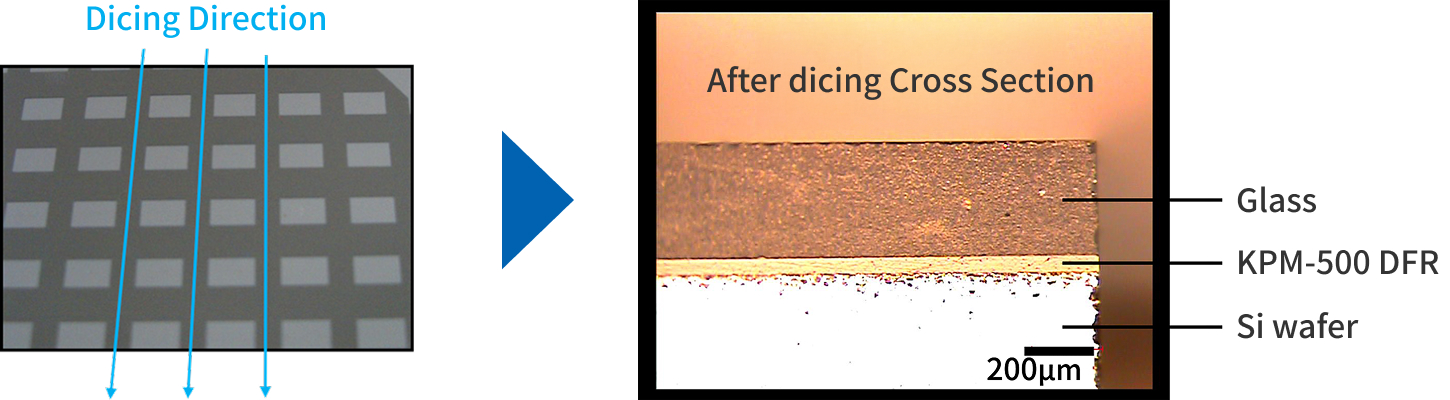
Si-Glass Bonding Cross‑section after dicing
The strong bond prevents delamination between the film and substrate even after the dicing process, ensuring high reliability.
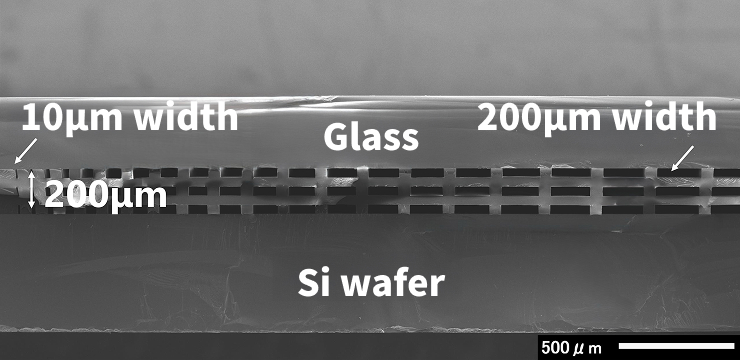
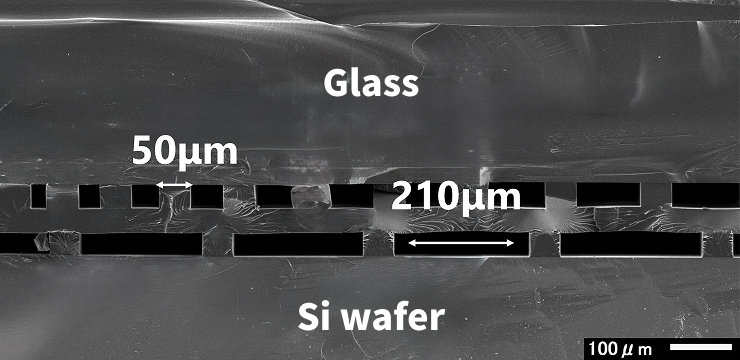
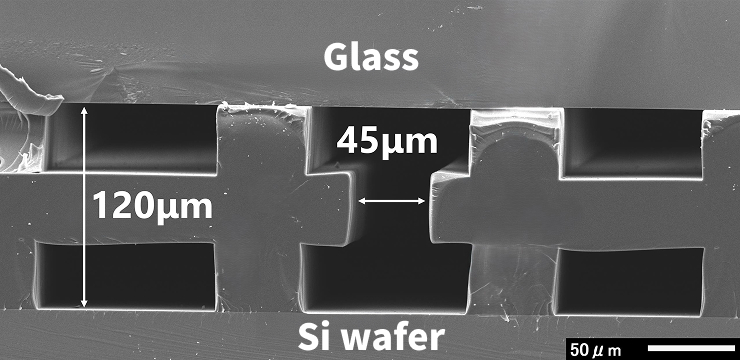
Multi‑Layer Structure Formation Using KPM DFR
This is an example of creating a multilayer structure by repeating lamination and photolithography. Structures that were difficult to fabricate using conventional methods can be achieved.
Process Flow of Fabrication

Multiple Layer fabrication with bonding
① Wide flow channels sealed with resin
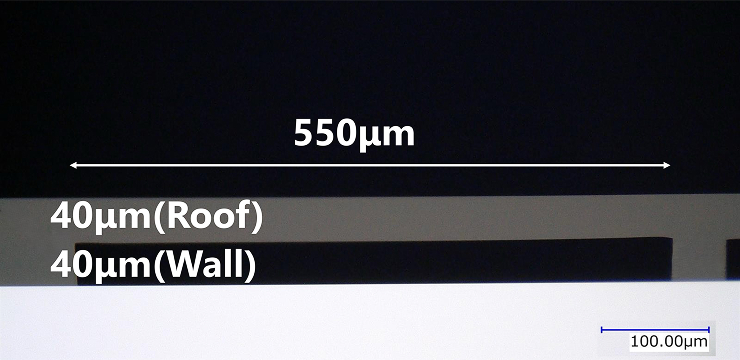
② Multi-layered, fine flow channels sealed with resin and glass
③ Through holes connecting upper and lower layers
④ A flow channel with a resin wall on a hollow structure
KPM-500 DFR Product Features
Major Film Properties (Reference Values)
Scroll horizontally to view more.
| Properties | Unit | KPM-500 DFR |
|---|---|---|
| Glass transition temperature (Tg) (DMA) | ℃ | 116 |
| Storage modulus (150°C, DMA) | MPa | 6 |
| Heat resistance (5% weight loss temperature in N2) | ℃ | 296 |
| Tensile strength (25°C) | MPa | 68 |
| Adhesion strength (shear strength on Si, 40 μm film thickness) | MPa | 72 |
| Adhesion strength (shear strength on Glass, 40 μm film thickness) | MPa | 74 |